

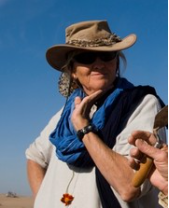
On December 2nd, the IAUNRC, in consortium with the Central Eurasian Studies Department, invited Dr. Alison Betts, Chair of Archaeology and Mythology of the Ancient Middle East at the University of Sydney, to deliver the highly anticipated Jean and Denis Sinor Faculty Fellowship Lecture for the fall semester. Betts incorporated an exhaustive depth of knowledge based on her own fieldwork in the Levant and Central Asia to offer compelling insight on Akchakhan-kala’s artistic, spiritual, and archaeological heritage.
Akchakhan-kala is a large, heavily fortified mud-walled city in the southern delta of the Amu-dar’ya. It lies in modern Karakalpakstan, ancient Chorasmia, near the town of Biruni. It was under study by the Karakalpak-Australian Expedition from 1994 to 2024 where excavations in the monumental buildings of the Upper Enclosure have revealed a unique and remarkable set of murals and painted plaster sculpture associated with a post-Achaemenid – pre-Sasanian Mazdean belief system. This is strongly linked to the power of the king as in the Persian tradition. The ancient Chorasmians of Akchakhan-kala had close relations with the Saka of the adjacent steppes, and some elements of pre-Zoroastrian ritual practice appear to have merged with Achaemenid derived traditions that characterize Akchakhan-kala. The architecture is highly ritual in nature and strongly associated with veneration of fire.

Dr. Betts began by honoring the legacy and contributions of the Department of Central Eurasian Studies’ own Denis Sinor, Distinguished Professor Emeritus of Central Asian Studies. She then laid a contextual groundwork for her analysis of Akchakhan-kala’s artifacts by explaining core tenets of Zoroastrian beliefs and institutions of spiritual practice. Examples ranged from headdresses found on coins from the fourth-century BCE to stylistically Persian illustrations of wild animals such as partridges and mules found next to depictions of Zoroastrian deities. Betts showed that Zoroastrian-Mazdean, Persian, and Central Asian rituals and beliefs blended in a unique form of religious practice that, she argues, was lost following the Sasanian institutionalization of religious practice under rulers like Bahram II.
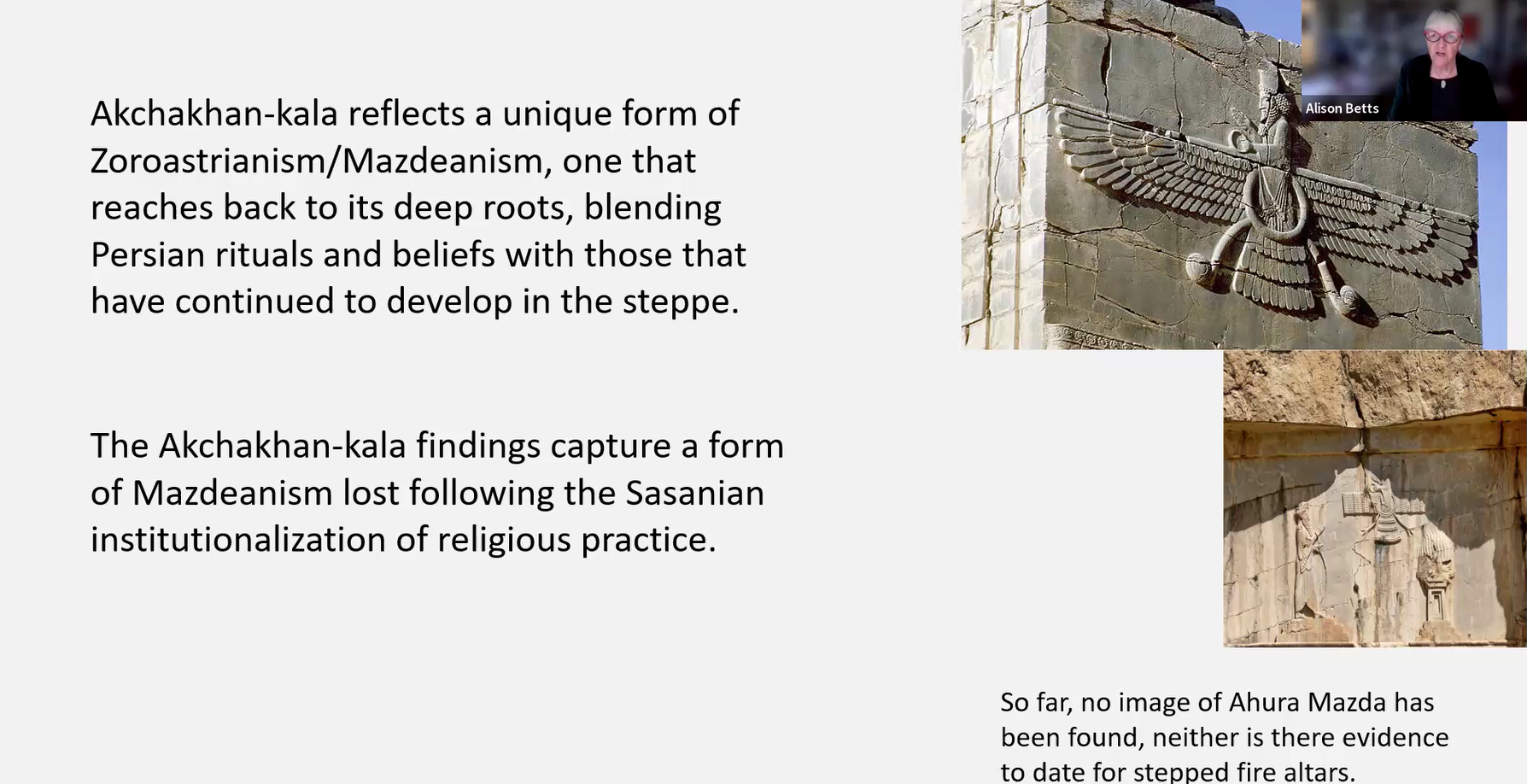
Betts concluded her talk by highlighting the importance of Zoroastrian-Mazdean religion in ancient Chorasmia due to the creational framework of beliefs established by the faith, particularly the role of Ahura Mazda in creating the notion of kingship and, subsequently, the indelible relationship of kings to the gods. Akchakhan-kala, accordingly, became a royal site of ceremony and ritual that spoke to this ineffaceable relationship. Zoroastrian-Mazdean faith, consequently, had a solidified role as a tool of propaganda and legitimization of political authority.
The IAUNRC thanks Dr. Betts for her fascinating talk that honored the memory of Jean and Denis Sinor and espoused a spirit of excellence in scholarship and collaboration.